Exchanging nets for rice: when vicious cycles hinder progress
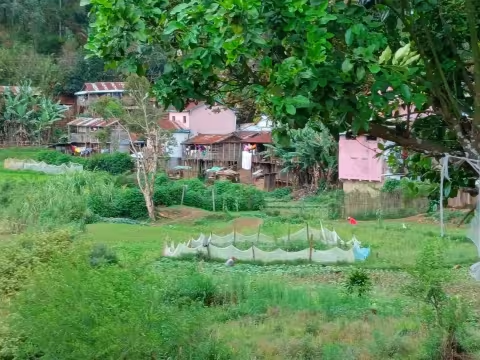
When poor farmers use insecticide-treated nets from malaria programmes to fence their fields, it may appear to be multisectoral collaboration – that is, the health sector supporting agriculture.
But this is not what we want!
It represents a poor use of societal resources and leaves the root causes unaddressed – and in facts makes things worse. Such farmers end up with fences that do not last. They do not sleep under the nets, contract malaria, become less productive, lose income and become poorer. They cannot afford malaria medicines, cannot invest in production, and may struggle to keep
their children in school.
So how, and from whom, do farmers get enough nets to make a fence?
They buy them!
In a rural village in Madagascar, a bed net can be bought for five to ten cups of rice, depending on the season. During the lean season – when food is scarcest and mosquito biting is highest – it costs fewer cups. The seller is the farmer’s poor neighbour, who desperately needs rice to feed her children.
This small yet complex and potent vicious cycle illustrates the close interlinkages between lack of development and malaria in communities left furthest behind. Poor farmers and their even poorer neighbours are trapped together in this cycle. They exchange nets for rice – and malaria for free. They both lose, the only winner is the parasite.
Wouldn’t it be better if entire villages could reduce malaria, increase yields, and generate employment and surplus – so they could improve housing, feed their children, keep them in school, use nets and medicines as intended, and become more economically and socially productive?
That is what a virtuous cycle looks like.
In a nutshell, the Pathfinder Endeavour is about getting more out of less and moving from vicious to virtuous along three pathways: (A) indivisible SDGs, (B) becoming malariasmart, and (C) 360degree accountability.
Following an RBMMSWG workshop in February 2025, twelve UN Volunteers from Australia, Cameroon, France, Germany, Hong Kong, India, Niger, Nigeria, South Sudan, Sudan, and Uganda explored how to make this happen. They searched for practical tools to enable true comprehensive multisectoral action – tools capable of breaking vicious cycles. In particular, they focused on approaches that not only improve malariacritical SDG indicators (defined as proportionbased measures), but also generate cobenefits across sectors, support districts to become malariasmart, and strengthen governance and overall health outcomes.
Crucially, these tools needed to be applicable in highly resourceconstrained settings.
They identified hundreds of promising tools already tested in reallife, resource constrained contexts. From these, 80 tools – one for each malariacritical SDG indicator – were adapted for inclusion in the Pathfinder Comprehensive Multisectoral Action Toolbox. The toolbox addresses, for example, more inclusive and responsive district decisionmaking, as well as reductions in youth unemployment, genderbased violence, land degradation, and household health expenditures, etc.
Pathfinder now works with governments and a large number of developments partners in Uganda, Madagascar and Cameroon to demonstrate how application of the tools and approaches can release synergies and get more out of existing structural, financial, human, and programmatic resources. The aim is to turn the vicious cycle into a virtuous one – and for the populations, economic, social and health gains to materialize and bring malaria elimination closer.
Erik Blas heads the Pathfinder Secretariat at UNDP and is a member of the RBM Multisectoral Working Group. The RBMMSWG brings together a diverse range of stakeholders across multiple sectors, including health, to align partners’ efforts in implementing new interventions while revitalising and strengthening existing ones through more coordinated and innovative approaches.
For more information on the working group,
please contact: konstantina.boutsika@endmalaria.org
Latest Stories of impact
World Health Assembly through the lens of an intern