World Health Assembly through the lens of an intern
Written by Westley Hannington Onyango
Five months ago, I joined the RBM Partnership to End Malaria as a communications intern. I had a decent grasp of media strategy, but when it came to global health, I had exactly zero background. No science degree, no public health training—just a massive learning curve and a severe case of imposter syndrome, feeling like a complete outsider who lacked the necessary background, qualifications, or expertise for the environment.
For the first few months, I was just trying to keep my head above water, learning the acronyms and trying to figure out what "vector control" actually meant. I managed to survive the rush of World Malaria Day and thought, “Okay, I’ve got this. I’m finding my rhythm.”
I was completely wrong. Nothing in my life could have prepared me for the beautiful, exhausting hurricane that is the World Health Assembly (WHA).
23 side events, 14-hour days, and a loaded Camera
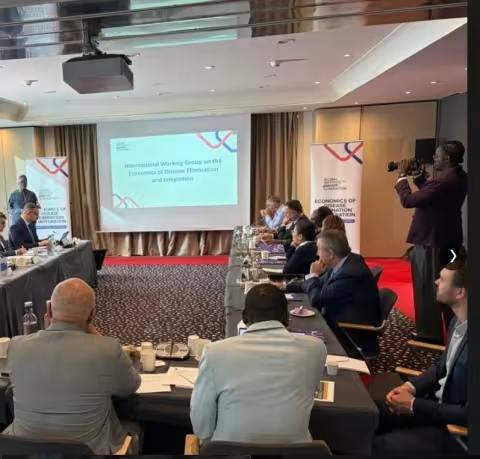
If you want to test an intern’s limits, throw them into WHA week. The pace was relentless: 23 side events crammed into seven days, 14-hour workdays that blurred together, and a neverending mountain of daily deliverables that had to go live immediately.
My primary mission was to capture the discussions, the moments . Luckily, I brought my secret weapon: my camera. Photography has been my favorite hobby for years, but suddenly, it was my lifeline. Armed with my lens, I ran from crowded conference halls to high-level meeting rooms, posting live updates and sweating through my business casual attire.
But a funny thing happens when you look at global health diplomacy through a camera viewfinder. While adjusting my shutter speed and trying to frame the perfect shot of a world leader, I wasn't just taking photos anymore. I was actually listening. And in the middle of that frantic week, the high-level jargon started making complete, human sense.
Seeing past the silos
As I focused my lens on panelist after panelist, a central theme started coming into focus: the stark tension between fragmentation and integration.
Historically, the global response to malaria has suffered from deep silos—disconnected country strategies, parallel health systems, and fragmented funding that essentially allow the disease to slip through the cracks. Listening to the debates, I realized that with the rising threats of insecticide and drug resistance, we can no longer afford to be divided by borders or bureaucracy.
Malaria programs have to be woven directly into the fabric of daily healthcare systems. We have to operate as one unified front.
Power of the crowd
Watching these rooms fill up also made me realize the sheer weight of the organization I was representing. Before WHA, RBM was just the place where I did my internship. But seeing it in action, I understood what it means to be the global health ecosystem’s premier convener.
I watched RBM bring over multisectoral partners from government ministers to private tech companies and grassroots civil society groups to the exact same table. Seeing that diverse crowd harmonizing their efforts showed me that we aren't working in isolation. We are marching collectively toward a single goal Ending Malaria
The quote that reframed everything
The most rewarding part of my grueling 14-hour days was capturing the raw, human emotion behind the policies. During one of the sessions, the Minister of Health of Brazil, Alexandre Padilha, said something that struck me so hard I almost forgot to hit the shutter button:
"Innovation without access is not innovation. Innovation without access is injustice. Innovation must be accessible, equitable and sustainable."
That moment reframed the entire week for me. All these breakthrough innovations I was posting about next-generation mosquito nets, newly rolled-out vaccines are completely meaningless if they don't reach the people who need them most. True victory means ensuring these tools reach the most vulnerable, remote communities, particularly the children under five who bear the heaviest burden of this disease. Without equity, as panelist Michael Anderson aptly noted later that week, "Innovation without access is false hope."
Finding my focus
By the end of the week, our discussions turned toward sustainability. We talked about how short-term funding cycles jeopardize decades of progress, and how sustainable financing is the only way to keep health systems resilient for the long haul.
Five months ago, I was an outsider trying to decipher global health code. Today, after surviving the craziest week of my career and witnessing the fierce dedication of global leaders through my camera lens, I finally got it.
We can't just manage malaria; we have to eliminate it. I might just be the intern holding the camera, but I’ve never been prouder to focus my lens on a malaria-free future.
Latest Stories of impact
Exchanging nets for rice: when vicious cycles hinder progress