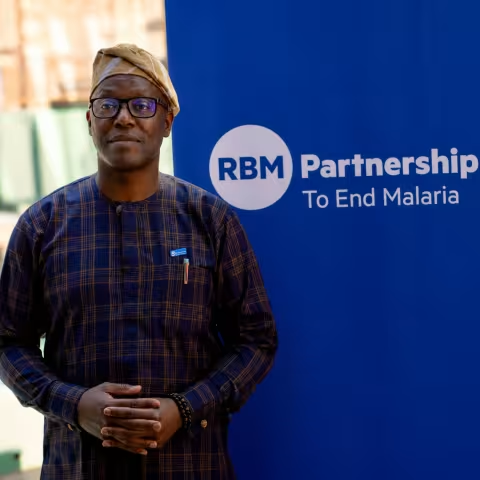
Botswana and RBM bring leaders together to advance malaria elimination
South African singer and RBM Board member Yvonne Chaka Chaka urged malaria leaders in Gaborone to give young people a greater say in how malaria programmes are designed. She made the call at the High-Level Dialogue on Malaria Elimination on 5 November, convened by the Government of Botswana and the RBM Partnership to End Malaria.
Chaka Chaka traces her malaria advocacy to 2005, when a musician in her band contracted malaria in Gabon and died after returning to South Africa. In 2018, her Princess of Africa Foundation donated 70,000 mosquito nets to Hlokomela for distribution to farming communities around Hoedspruit and Tzaneen.
Botswana recorded 290 malaria cases in 2024 and 2,451 the following year. The country aims to end local transmission by 2029. As Minister of Health Hon. Dr Stephen Modise explained in Gaborone, malaria control now continues year-round. For Botswana and its neighbours, that means keeping people protected as transmission persists across borders and budgets are stretched.
For Dr Michael Adekunle Charles, Chief Executive Officer of the RBM Partnership to End Malaria, the starting point is for countries to use their national plans and local data to guide investment. The Dialogue brought governments and their partners together to look at what that means in practice, from coordinating malaria prevention across borders to financing services that can reach people throughout the year.
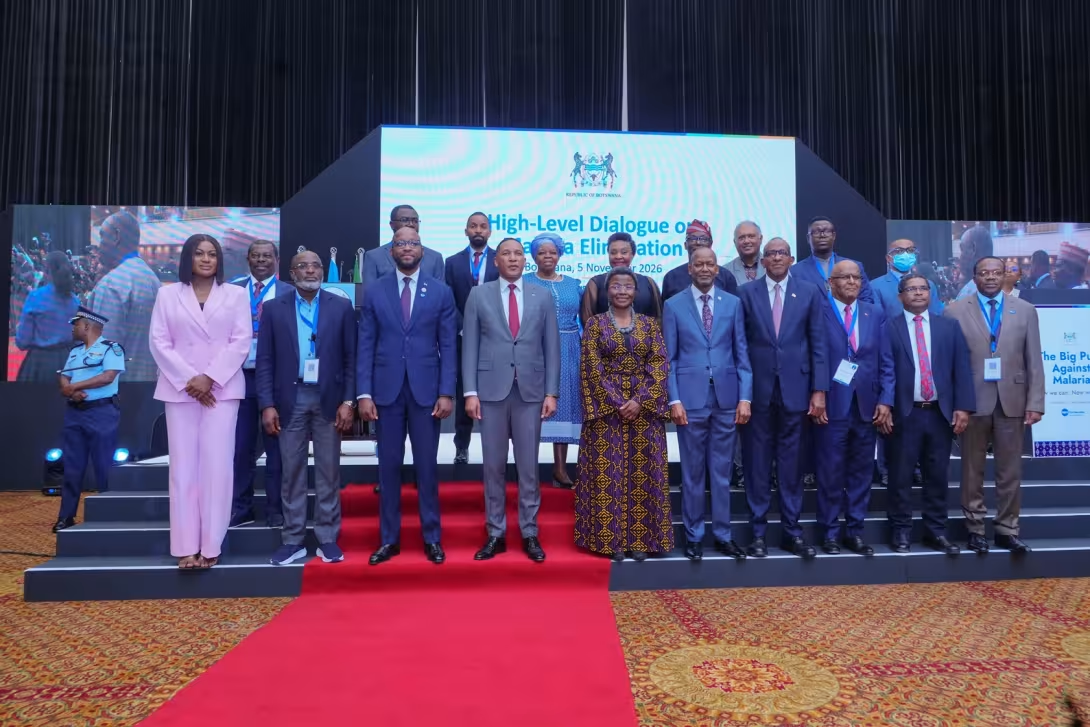
Leaders and dignitaries at the Dialogue
The 5 November 2026 Dialogue took place alongside the 36th RBM Partnership Board Meeting. The RBM Partnership thanks Board Chair Joy Phumaphi and the Board members who took part in the Dialogue for bringing perspectives from across the Partnership to the discussions in Gaborone. The Government of Botswana and the RBM Partnership to End Malaria co-hosted the Dialogue, where President Advocate Duma Gideon Boko, President of the Republic of Botswana and Chair of the African Leaders Malaria Alliance (ALMA), addressed participants. President Boko highlighted Botswana’s End Malaria and Neglected Tropical Diseases Council, launched on 22 October to bring government, business and traditional leaders together to mobilise domestic resources.
“Country ownership means shaping, designing and evaluating investments according to the specific needs of communities,” President Boko said.
The RBM Partnership welcomed the participation of health ministers and senior government representatives from Angola, Botswana, Equatorial Guinea, Kenya, Namibia, Sudan and Zambia, as well as His Excellency Elias Mpedi Magosi, Executive Secretary of the Southern African Development Community (SADC). They brought national and regional experience of malaria surveillance, prevention and access to care. Hon. Njume Peter Ambang, Member of the National Assembly of Cameroon and Co-Chair of the Coalition of Parliamentarians to End Malaria in Africa, highlighted how legislators use evidence from civil society to scrutinise malaria spending.
The Dialogue also welcomed Kgosi Malope II, Chairperson of Botswana’s Ntlo ya Dikgosi (House of Chiefs), and Her Regal Majesty Olori Ambassador Dr Temitope Enitan-Ogunwusi of the royal court of Ife, Nigeria, Deputy Convener of the Hopes Alive Initiative for Africa. South African singer and malaria advocate Yvonne Chaka Chaka, widely known as the Princess of Africa, helped guide the day’s proceedings and called for young people to help shape malaria programmes. She is Founder and Director of the Princess of Africa Foundation and a member of the RBM Partnership Board.
From the kgotla to the border
Kgosi Malope II planned to take the discussion back to the kgotla, Botswana’s community assembly, where families could talk about when to get tested, how to use mosquito nets and why indoor spraying matters.
A mosquito net campaign can miss households even when distribution figures look encouraging. Community groups can spot those gaps or flag that a clinic has run out of supplies, provided they have the funds to do that work. Hope for Future Generations called for funding so communities can report these gaps. Olori Enitan-Ogunwusi recalled joining a net distribution in rural Nigeria and urged programmes to involve traditional leaders while campaigns are still being planned.
At a border, timing matters too. Namibia and Angola have discussed coordinating indoor spraying along their shared border. Zambia’s experience using surveillance to find pockets of persistent transmission shows what neighbours can gain by sharing data. In Sudan, teams reported reaching displaced families with nets during conflict and introducing malaria vaccination in Gedaref and Blue Nile in 2024. Each example turns on knowing who is at risk and what it will take to reach them.
Getting nets to households starts with choosing ones that work where they will be used. Where mosquitoes have developed resistance to pyrethroids, nets treated with both a pyrethroid and chlorfenapyr can help protect children, explained Dr Corine Ngufor, Co-Chair of RBM’s Vector Control Working Group. Patrick Sieyes, Strategic Partnerships and External Affairs Director at Vestergaard, called for predictable orders and a common regulatory pathway. Reflecting on the Dialogue on LinkedIn, he said the industry needed to “innovate faster than the mosquito mutates”.
Making the case before the next budget
What does a year of malaria prevention buy? RBM Board Chair Joy Phumaphi asked advocates to make that case to finance ministries in terms of school days and working days saved. A year-round response also means budgeting for surveillance, health workers and the supplies they need. Who gets a say in how that money is spent also matters. Farida Tiemtoré of the Global Fund’s Youth Council called for funding to give young women a place on the committees that make programme decisions.
Competing national priorities were the most frequently cited obstacle in a survey at the Dialogue. Participants identified a role for RBM in helping countries make the case for domestic funding. That could mean helping a country cost a gap in its malaria plan and show finance ministries and legislators what closing it would deliver. Peter Sands, Executive Director of the Global Fund to Fight AIDS, Tuberculosis and Malaria, called for donor funding to build on stronger domestic investment. The discussion also examined how development banks could help prepare projects for investment and how philanthropy could cover the cost of getting tools to families.
In his closing remarks, Dr Charles called for stronger frontline services and closer cross-border cooperation. He also urged countries to include malaria in their national health financing plans so that prevention and care can be funded year-round. Through the Big Push Against Malaria, RBM gives partners a way to coordinate their support around the priorities countries set.
The RBM Partnership thanks the UK Foreign, Commonwealth & Development Office (FCDO) and the Gates Foundation for their financial support, and ALMA, Goodbye Malaria and Vestergaard for their in-kind contributions to this event.
The Dialogue ended with song and dance. “The Big Push will only work if we all push together,” Joy Phumaphi said as the Dialogue closed.
Latest Press releases
RBM MiPWG Co-Chair election